CS-466/566: Math for AI

Module 03: Linear Regression

Dr. Mahmoud Mahmoud

The University of Alabama

2026-03-23

TABLE OF CONTENTS

1. Linear Regression Definition
2. Weights and Bias
3. How do machines learn linear regression?
4. Loss Function (Error Function)
5. Reducing Loss (Gradient Descent)
6. Convergence and Learning Rate
7. Multivariate Linear Regression
8. Normal Equation

Linear Regression

Can you design a linear road that pass by all these houses equally?!

Linear Regression

Can you design a linear road that pass by all these houses equally?!

Housing Prices Problem

  • What are the features and labels here?
  • Is it classification or regression problem?
  • What is the price of the house of 4 rooms?
  • What is the price per extra room? (#Room \(\times\) weight)
  • What is the base price? (Bias)
  • What is the equation that represents the price?
  • Price = 100 + 50 * (#Rooms)

TABLE OF CONTENTS

1. Linear Regression Definition
2. Weights and Bias
3. How do machines learn linear regression?
4. Loss Function (Error Function)
5. Reducing Loss (Gradient Descent)
6. Convergence and Learning Rate
7. Multivariate Linear Regression
8. Normal Equation

Weights and Bias

Price Equation

Price = 100 + 50 * (#Rooms)

WEIGHTS

Each feature gets multiplied by a corresponding factor. These factors are the weights. In the above formula the only feature is the number of rooms, and its value is 50.

BIAS

Constant that is not attached to any of the features. It is called the bias. In this model, the bias is 100 and it corresponds to the base price of a house.

How do machines learn this equation?

TABLE OF CONTENTS

1. Linear Regression Definition
2. Weights and Bias
3. How do machines learn linear regression?
4. Loss Function (Error Function)
5. Reducing Loss (Gradient Descent)
6. Convergence and Learning Rate
7. Multivariate Linear Regression
8. Normal Equation

How machines learn it? [Remember-Formulate-Predict]

How machines learn it? [Remember-Formulate-Predict]

Linear Regression

Price = 100 + 50 * (#Rooms)

Slope

Measures how steep the line is.

Y-intercept

It is the height at which the line crosses the vertical (y) axis.

Linear Equation

Linear Equation is the equation of a line. \(y=mx+b\)

How many lines can solve the problem?

How machines learn it? [Remember-Formulate-Predict]

Price = 100 + 50 \(\times\) (#Rooms)
Price = 100 + 50 \(\times\) (4) = 300

Some Questions:

  • Can we have multiple features data?
  • How does computer learn this equation?

Multivariate Linear Regression

Price = 30 * (#Rooms) + 1.5 * (Size) + 10 * (Schools Quality) - 2 * (Age) + 50

What do you notice in this equation?
  • 1 bias and multiple weights
  • Different sign of weights
  • Different weights value
  • What is the shape of the model? Still linear?

How machines formulate this equation? [Overview]

Inputs: A dataset of points.
Outputs: A linear regression model that fits that dataset.

Procedure:
  • Pick a model with random weights and a random bias.
  • Repeat many times:
    1. Pick a random data point.
    2. Slightly adjust the weights (Slope) and bias (y-intercept) in order to improve the prediction for that particular data point.
  • Return the model you’ve obtained.

How machines formulate this equation? [Overview]

Linear Relationship

A linear relationship
  • True, the line doesn’t pass through every dot.
  • However, the line does clearly show the relationship between rooms and price.

\[ y' = mx + b \]

where: - y’: is the price value that we’re trying to predict. - m: is the slope of the line. - x: is the number of rooms value of our input feature. - b: is the y-intercept.

Linear Relationship in Machine Learning

In machine learning, we’ll write the equation for a model slightly differently:

\[ y' = w_1x_1 + w_0 \]

where: - y’: is the predicted label (a desired output). - w₁: is the weight of feature 1. Weight is the same concept as the “slope”. - x₁: is feature 1. - w₀ or b: is the bias (the y-intercept).

Training and Loss

  • Training a model simply means learning (determining) good values for all the weights and the bias from labeled examples.
  • Loss is the penalty for a bad prediction.
    • Perfect prediction means the loss is zero.
    • Bad model have large loss.

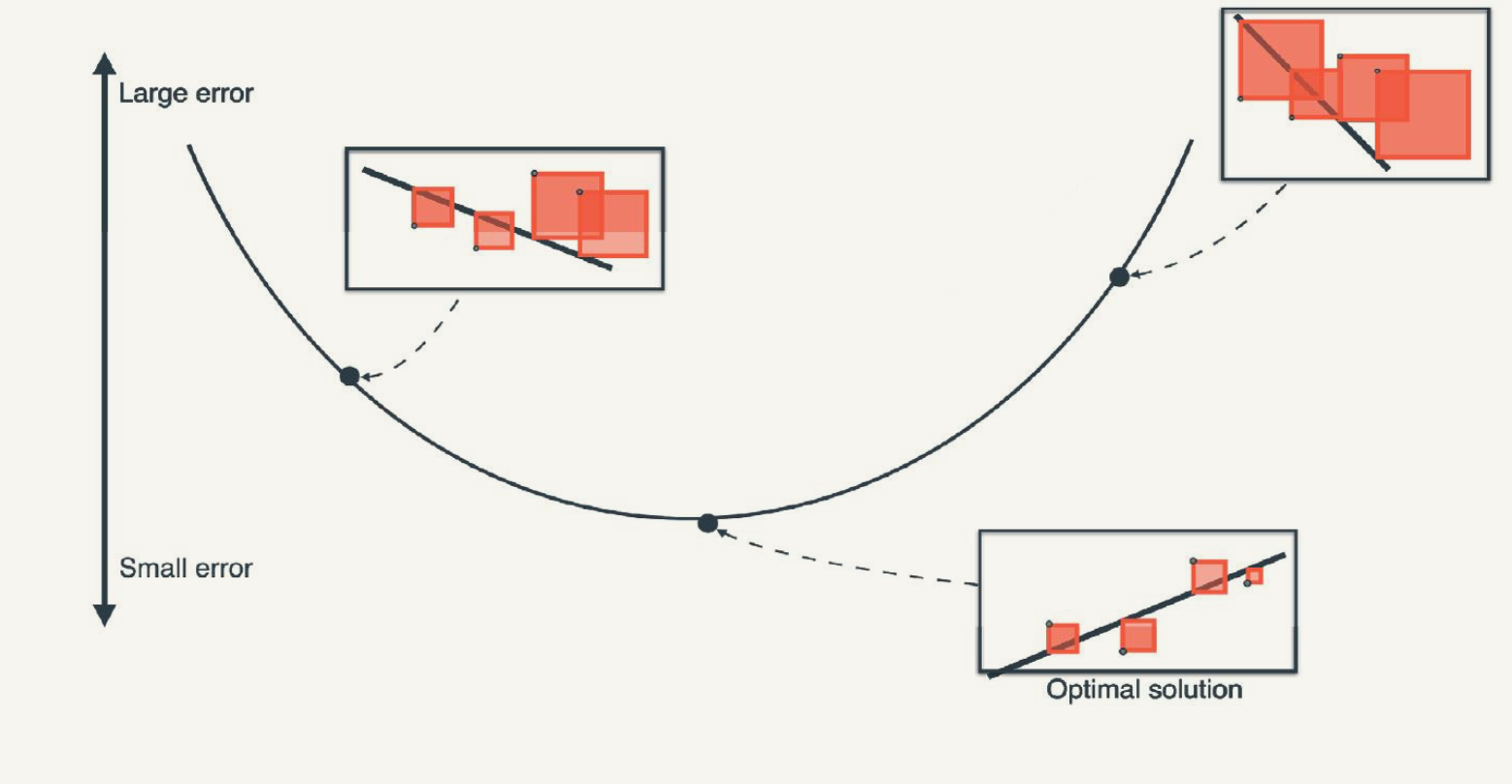
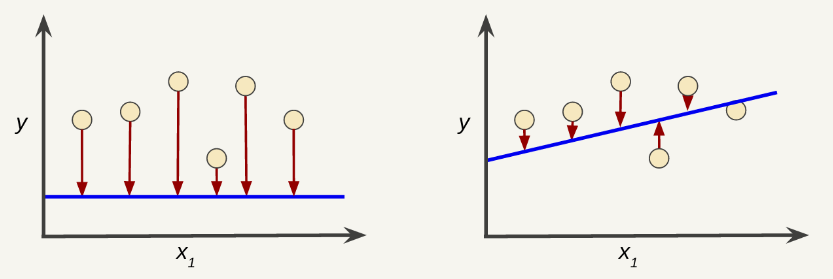
Suppose we selected the following weights and biases. Which of them have lower loss?
Reducing Loss

  • Training is a feedback iterative process that uses the loss function to improve the model parameters.
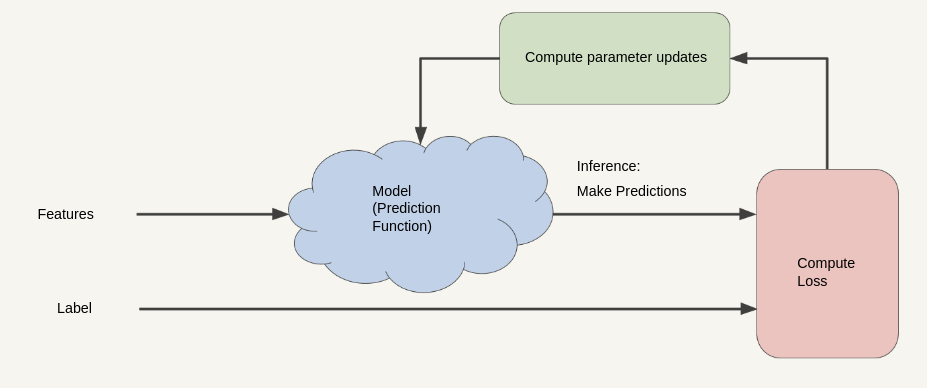
Some Questions: - How to define loss to measure the performance of the model? - What initial values should we set for \(w_1\) and \(w_0\)? - How to update \(w_1\) and \(w_0\)?

TABLE OF CONTENTS

1. Linear Regression Definition
2. Weights and Bias
3. How do machines learn linear regression?
4. Loss Function (Error Function)
5. Reducing Loss (Gradient Descent)
6. Convergence and Learning Rate
7. Multivariate Linear Regression
8. Normal Equation

Loss Definition

Which model is better and why? Which model have a lower loss?

Absolute Loss (L1 Loss)

The absolute loss is the sum of the absolute differences between the observed and predicted values.

\(| \text{observation}(x) - \text{prediction}(x) | = |(y-y')|\)

Absolute Loss (L1 Loss)

The absolute loss is the sum of the absolute differences between the observed and predicted values.

Squared Loss (L2 Loss)

The squared loss is the sum of the squared differences between the observed and predicted values.

\([ \text{observation}(x) - \text{prediction}(x) ]^2 = [(y-y')]^2\)

Squared Loss (L2 Loss)

The squared loss is the sum of the squared differences between the observed and predicted values.

Why Squared Loss?

  • The squared loss is used in many machine learning algorithms because it penalizes larger errors more than smaller ones. This property makes it more sensitive to outliers compared to absolute loss.
  • The squared loss also leads to a nicer derivative compared to the absolute loss, which simplifies optimization algorithms like gradient descent.

Mean Square Error (MSE)

Is the average squared loss per example over the whole dataset.

\[ \text{MSE} = \frac{1}{N}\sum\limits_{(x,y)\in D}(y-\text{prediction}(x))^2 \]

  • (x,y) is an example in which
    • y is the label
    • x is a feature
  • prediction(x) is equal to \(y' = w_1x+w_0\)
  • D is the dataset that contains all (x,y) pairs
  • N is the number of samples in D

TABLE OF CONTENTS

1. Linear Regression Definition
2. Weights and Bias
3. How do machines learn linear regression?
4. Loss Function (Error Function)
5. Reducing Loss (Gradient Descent)
6. Convergence and Learning Rate
7. Multivariate Linear Regression
8. Normal Equation

Gradient Descent (Recap)

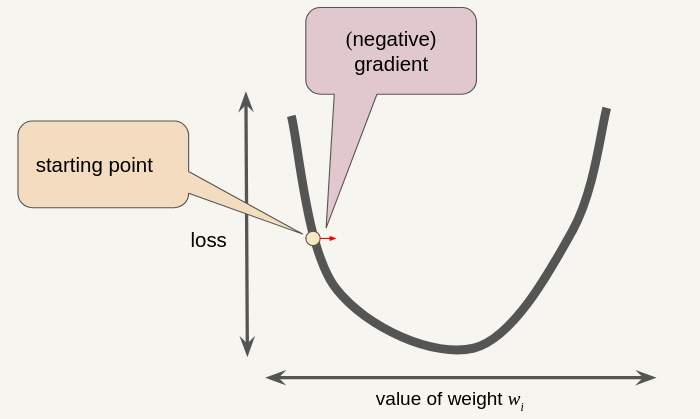
Note that a gradient is a vector, so it has both of the following characteristics: - Magnitude - Direction
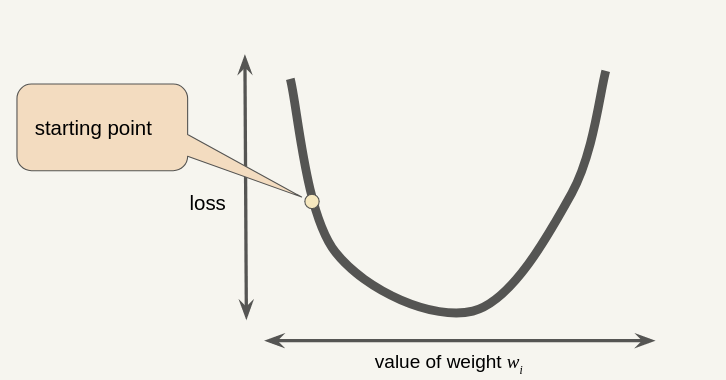
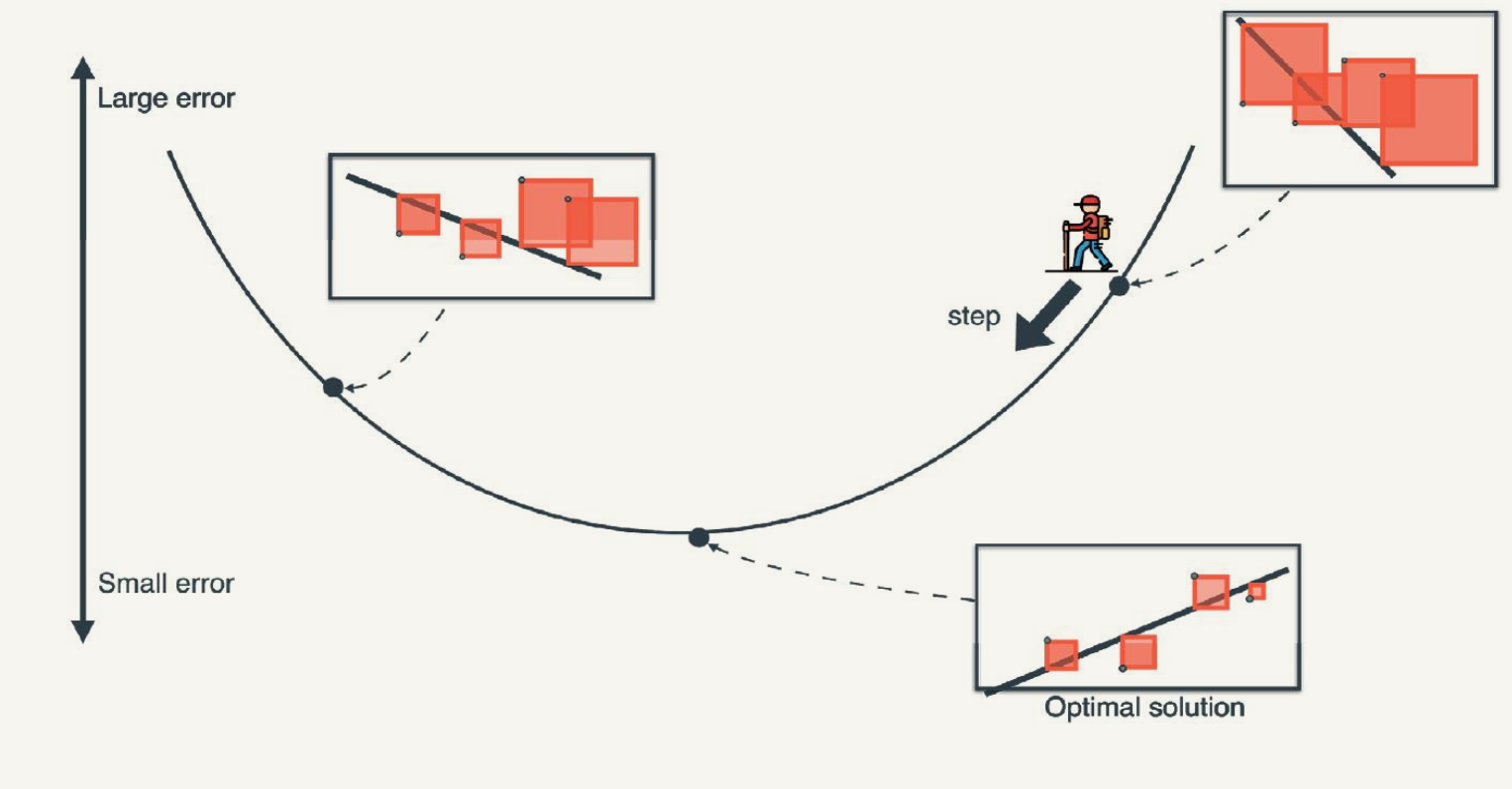
The gradient descent algorithm takes a step in the direction of the negative gradient.
The gradient descent algorithm adds some fraction of the gradient’s magnitude (Learning Rate \(\eta\)) to the previous point.
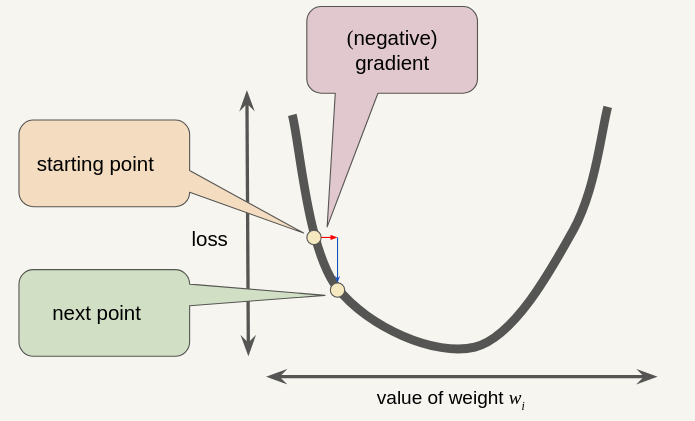
\[ w_{new} = w_{old} - \eta \cdot \frac{d\ \text{loss}}{dw} \]

Gradient for Linear Regression

  • For linear regression, the gradient of the loss function with respect to the weights \(w_1\) and \(w_0\) can be derived as follows:
  • The loss function for linear regression is typically the l2 loss:

\[ \text{loss}(w_0, w_1) = [y - y']^2 = [y - (w_1x + w_0)]^2 \]

  • The gradient of the loss function with respect to the weights \(w_1\) and \(w_0\) can be derived as follows:

\[ \frac{d\ \text{loss}}{dw_1} = 2(y - y')(-x) = 2x(y' - y) \] \[ \frac{d\ \text{loss}}{dw_0} = 2(y - y')(-1) = 2(y' - y) \]

Full Gradient for Linear Regression

Procedure:

  • Pick random weight w₁ and a random bias w₀.
  • Repeat many times:
    1. Pick a random data point \((x^{(i)},y^{(i)})\).

    2. Compute Model Prediction \(y'^{(i)} = w_1x_1^{(i)} + w_0\)

    3. Update the weights and bias using the following equations:

      \[ \color{red}{w_1} = \color{red}{w_1} - \eta \frac{d\ \text{loss}}{dw_1} = \color{red}{w_1} - \eta 2x_1^{(i)}(\underbrace{y'^{(i)}-y^{(i)}}_{\color{red}{\text{error}}}) \] \[ \color{red}{w_0} = \color{red}{w_0} - \eta \frac{d\ \text{loss}}{dw_0} = \color{red}{w_0} - \eta 2(\underbrace{y'^{(i)}-y^{(i)}}_{\color{red}{\text{error}}}) \]

  • Return the model you’ve obtained.

Gradient Descent for Linear Regression
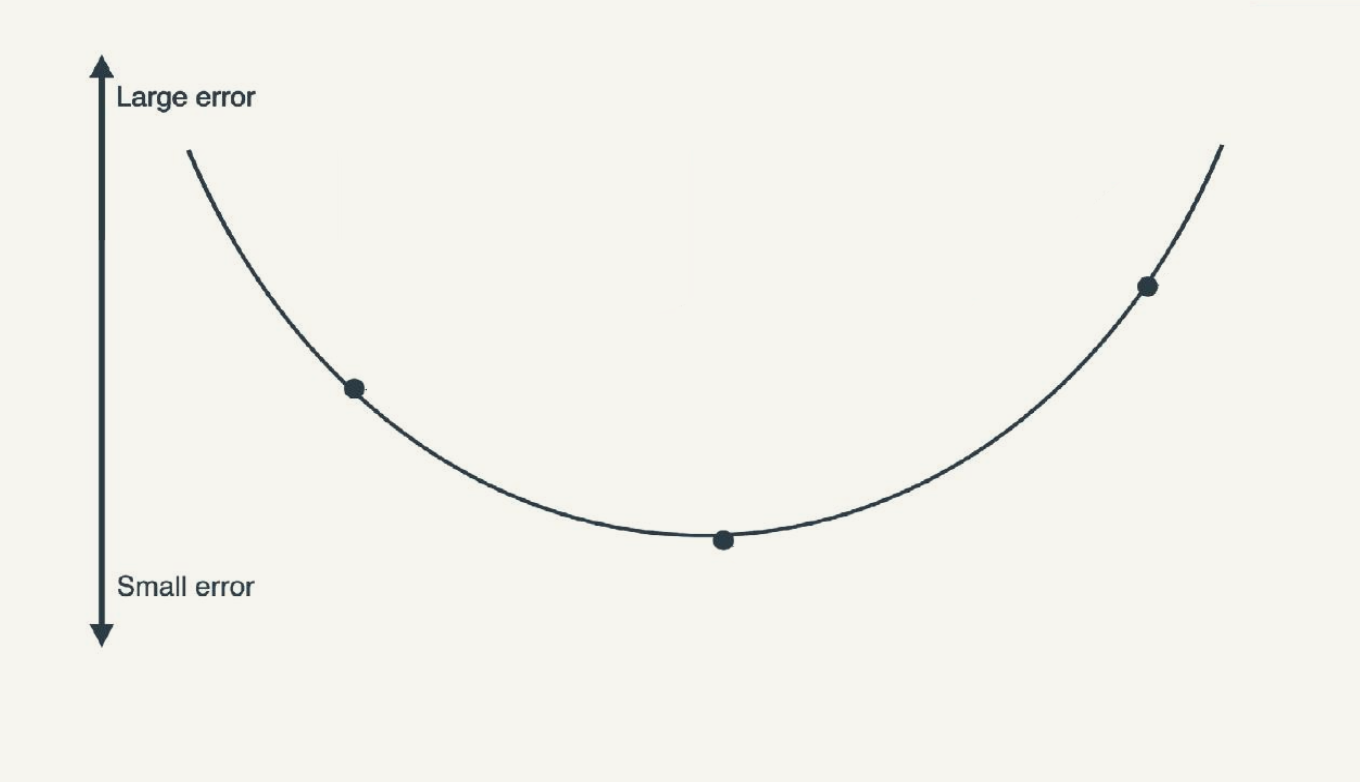
TABLE OF CONTENTS

1. Linear Regression Definition
2. Weights and Bias
3. How do machines learn linear regression?
4. Loss Function (Error Function)
5. Reducing Loss (Gradient Descent)
6. Convergence and Learning Rate
7. Multivariate Linear Regression
8. Normal Equation

Convergence Criteria

  • For convex functions, optimum occurs when: \[ \left| \frac{d\ \text{loss}}{dw} \right| = 0 \]
  • In practice, stop when: \[ \left| \frac{d\ \text{loss}}{dw} \right| \le \epsilon \]

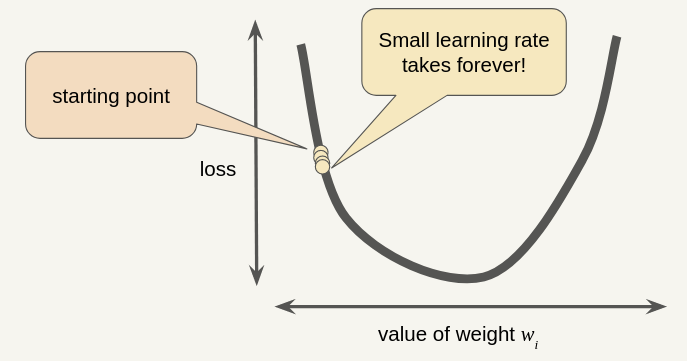
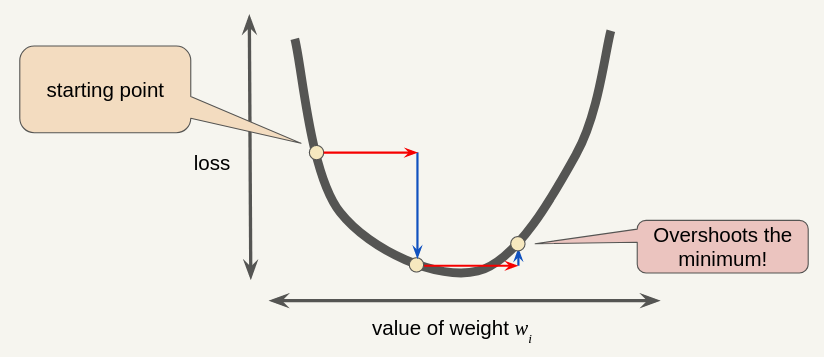
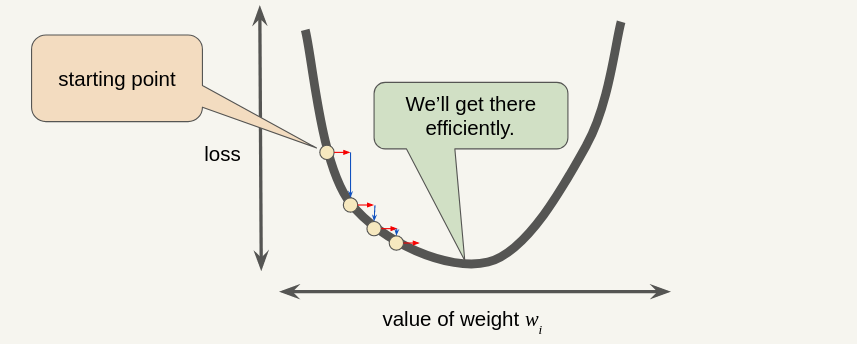
Learning Rate

  • Gradient descent algorithms multiply the gradient by a scalar known as the learning rate (also sometimes called step size).
  • How can we choose the learning rate?

Small Learning Rate
Large Learning Rate
Optimal Learning Rate (usually 0.01)
Types of Gradient Descent

  • Batch Gradient Descent:
    • MSE loss assumes taking gradient for the total number of samples in the data set.
    • Data sets often contain billions or even hundreds of billions of examples.
    • Can take a very long time to compute.
  • Stochastic Gradient Descent (SGD):
    • Uses only a single example (a batch size of 1) per iteration.
    • Very noisy.
  • Mini-Batch Gradient Descent:
    • Compromise between full-batch iteration and SGD.
    • Typically a batch of size between 10 and 1,000 examples, chosen at random.

TABLE OF CONTENTS

1. Linear Regression Definition
2. Weights and Bias
3. How do machines learn linear regression?
4. Loss Function (Error Function)
5. Reducing Loss (Gradient Descent)
6. Convergence and Learning Rate
7. Multivariate Linear Regression
8. Normal Equation

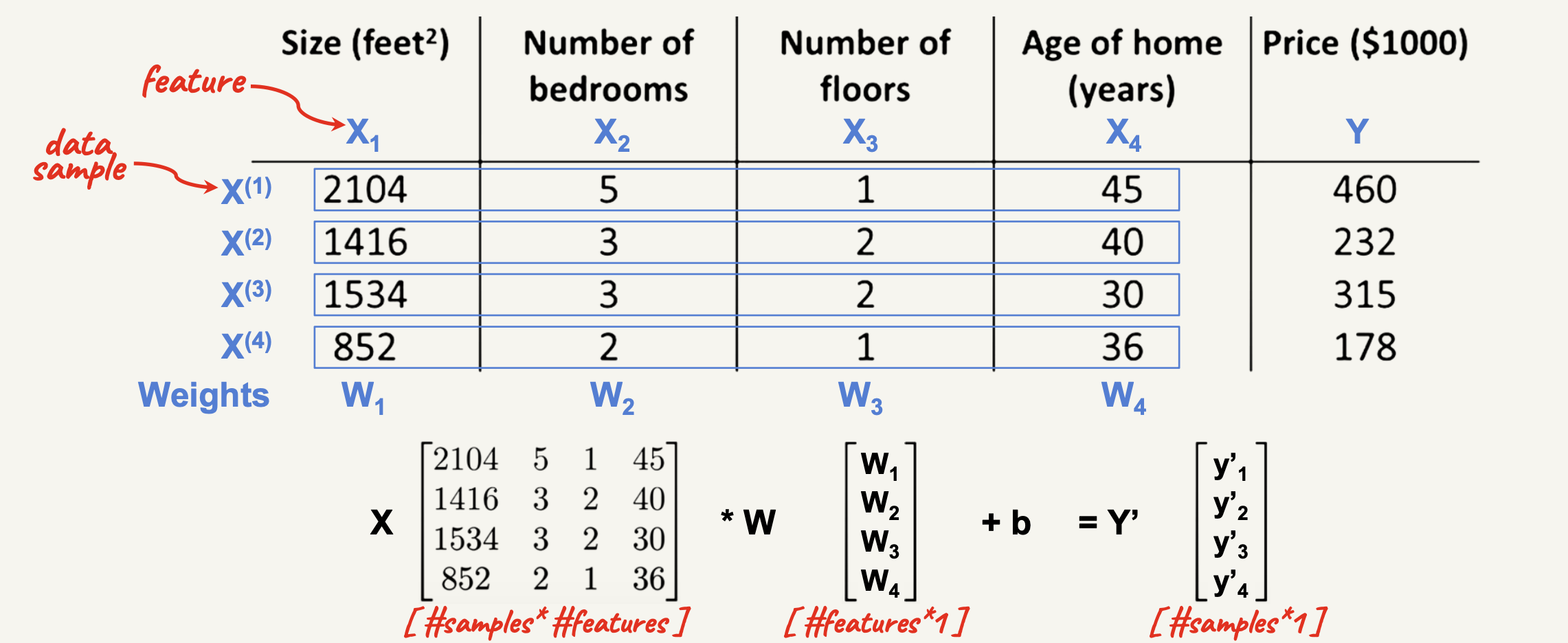
Multivariate Linear Regression

  • The general case of linear regression has more than one input feature.
  • The model now becomes:

\[ y' = w_1x_1 + w_2x_2 + \dots + w_nx_n + w_0 \]

  • We can rewrite this as:

\[ y' = \sum\limits_{i=0}^{i=n} w_i x_i \]

  • Note \(w_0\) is the bias (intercept), and \(x_0 = 1\).

Generalization and Gradient

  • For \(n\) features: \(y' = \sum\limits_{i=0}^{i=n} w_i x_i\)
  • Note \(w_0\) is the bias (intercept), and \(x_0 = 1\).
  • Vector representation: \(y' = \textbf{w}^T \textbf{x}\)
  • Loss = \(\ell = (y-y')^2\)

Gradient Derivation \[\begin{align*} \frac{d\ell}{dw_i} &= \frac{d\ell}{dy'} \frac{dy'}{dw_i} \\ &= 2(y'-y) \cdot x_i \end{align*}\]

Multivariate Output Visualization

TABLE OF CONTENTS

1. Linear Regression Definition
2. Weights and Bias
3. How do machines learn linear regression?
4. Loss Function (Error Function)
5. Reducing Loss (Gradient Descent)
6. Convergence and Learning Rate
7. Multivariate Linear Regression
8. Normal Equation

The Normal Equation

Normal Equation Closed-Form

  • Normal equation is a closed-form solution to the linear regression problem.

  • It provides an exact solution to the model parameters \(\textbf{W}\) that minimize the squared error.

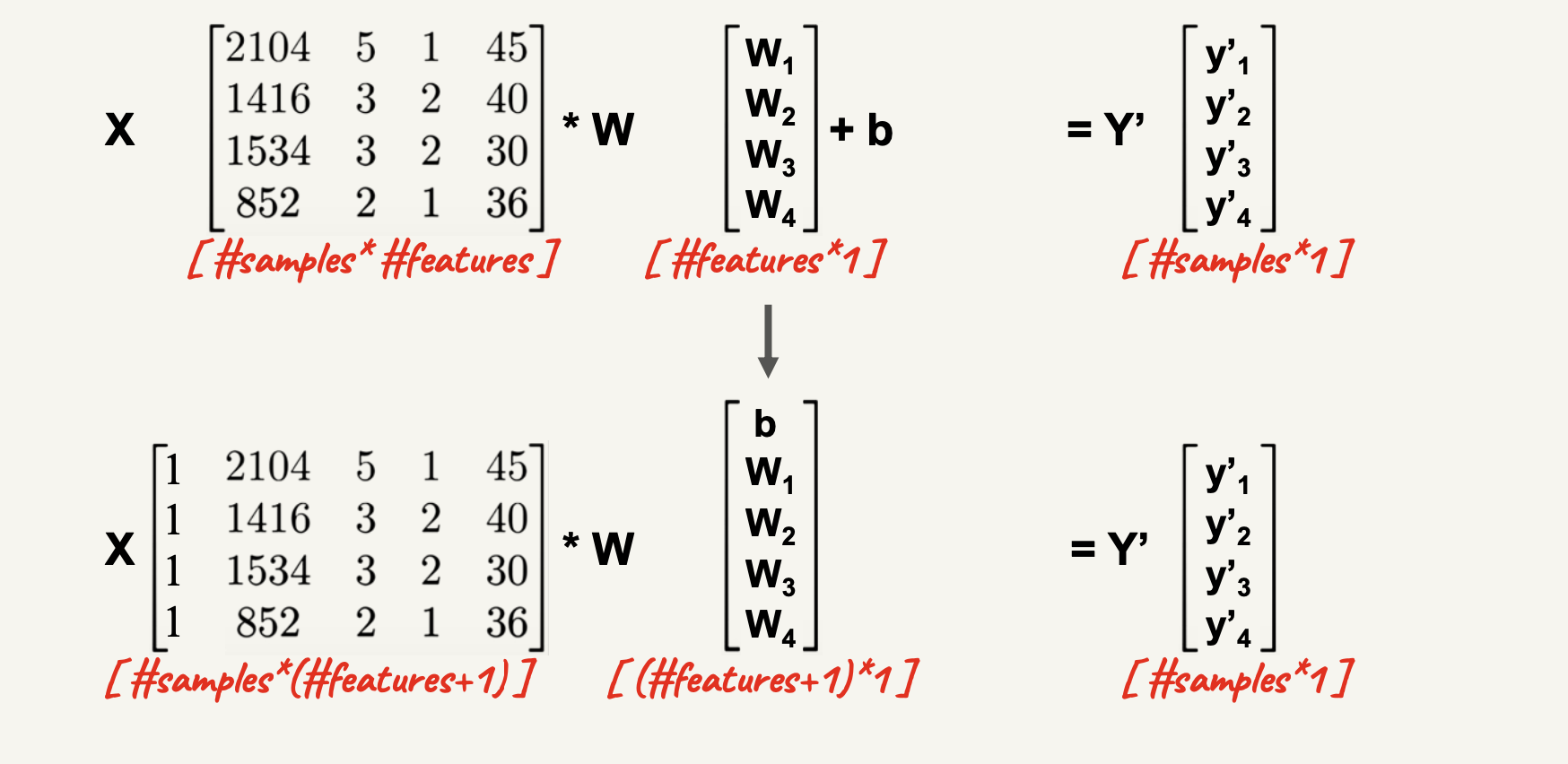
  • Since we have: \[ \textbf{Y} = \textbf{X} \cdot \textbf{W} \]

  • Multiply both sides by the inverse of \(\textbf{X}\): \[ \textbf{X}^{-1} \cdot \textbf{Y} = \textbf{W} \]

  • Since \(\textbf{X}\) is not a square matrix, we can’t find the inverse of \(\textbf{X}\).

  • We can use the following trick: \[ \textbf{X}^T \textbf{Y} = \textbf{X}^T \textbf{X} \textbf{W} \]

  • Now, multiply both sides by the inverse of \(\textbf{X}^T \textbf{X}\):

    \[ (\textbf{X}^T \textbf{X})^{-1} \textbf{X}^T \textbf{Y} = \textbf{W} \]

Thank You!